DEMOCRACY: Abdulsalami Abubakar and the Birth of the Fourth Republic
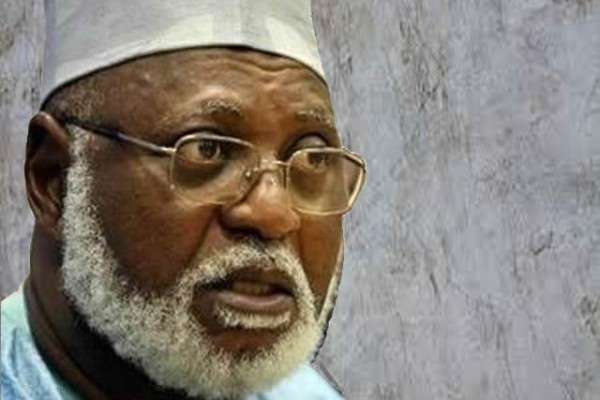
Surprising some critics of the Nigeria's military, General Abdulsalami Abubakar, GCFR, handed over power to the newly elected civilian president, Chief Olusegun Obasanjo, in May 29, 1999, a stint that saw him bow out of office into retirement from the army, but yet paved a new era for the country's democracy, which has endured till this day.
Abubakar, born 13 June 1942, served as the military head of state of Nigeria from 1998 to 1999, graduating from Chief of Defence Staff (1997 to 1998), succeeding General Sani Abacha on 9 June 1998 upon the latter's death. However, Abubakar's journey into the Nigerian was by providence as he did not directly join the institution, but by a decision driven by circumstance.
After finishing at the Provincial Secondary School, Bida, in 1962, Abubakar got admission into the Technical College, Kaduna. However, having also attended an interview for the Nigerian Military Training College (NMTC), now known as the Nigerian Defence Academy (NDA), he opted for a military career and was enlisted into the newly formed Nigerian Air Force (NAF) in 1963. He was sent for training in Germany, but was forced to drop out as he could not take part in the final round of training. On his return to Nigeria, he transferred to the Nigerian Army, where luck smiled on him.
Nigeria had been ruled by military leaders since Muhammadu Buhari seized power from democratically elected President Shehu Shagari in a 1983 coup. Although democratic elections had been held in 1993, they were annulled by General Ibrahim Babangida.
During his leadership after being sworn-in as military head of state, Nigeria adopted a modified version of the 1979 Constitution, which provided for multiparty elections. In just a few days after assuming office, Abubakar promised to hold elections within a year and transfer power to an elected president. His government established the Independent National Electoral Commission (INEC) and appointed former Supreme Court Justice Ephraim Akpata as its chairman.
The INEC held a series of elections, first for Local Government Areas in December 1998, then for State Assemblies and Governors, National Assemblies and finally for the President on 27 February 1999. Although efforts were made to ensure that the elections were free and fair, there were widespread irregularities that drew criticism from foreign observers.
In terms of economics, his government advocated for a privatisation programme which was announced on the 20 July 1998, in which the government retained 40% of the telecom, electricity, petroleum refineries, coal and bitumen production, tourism, and spill-overs from the first phase of privatisation equities of the affected enterprises whilst 40% will be alienated to strategic investors with the right technical, financial and management capabilities. His political economy was said to be almost a direct diversion from that of his predecessors to acquire international legitimacy. Further he advocated for economic liberalization, deregulation and foreign investment.
However, despite keeping to his promise that birthed democracy in the new era, Abubakar's legacy has been a mixture of criticism and praise. A lecture circuit at Chicago State University in Chicago, Illinois, United States featuring him encountered opposition because he had supported Abacha's government, whose administration was notorious for its human rights abuses and accused as responsible for the death of 1993 president-elect Moshood Kashimawo Olawale Abiola, who died in custody after being prevented by Abacha from taking office, and for the violation of the rights of others during his administration.
On the other hand, Abubakar helped in the Liberian peace movement by presiding over the 2003 peace talks between Charles Taylor and the opposing rebels. This is seen in the movie 'Pray the Devil Back to Hell.' He also chaired the Commonwealth Observer Group to the Zimbabwe presidential election in 2002, which concluded that "the conditions in Zimbabwe did not adequately allow for a free expression of will by the electors". He is the currently the Chairman of the National Peace Committee.
Abubakar, who is married to Fati and together they have six children, has received several awards and medals including Defence Service Medal (DSM), Defence Service Medal (Nigeria), Distinguished Service Medal (DSM), Forces Service Star (FSS), Forces Service Star (Nigeria), General Service Medal (GSM), General Service Medal (Nigeria), Grand Commander of the Order of the Federal Republic of Nigeria (GCFR), International Gold Medal of the Economic Community of West African States, Meritorious Service Star (MSS), National Service Medal (NSM), National Service Medal (Nigeria), Republic Medal (RM), Rainbow/PUSH Coalition Peace Prize, Silver Jubilee Medal (SJM), Order of the Star of Ghana, and Ufuk Dialogue Peace Award 2022.
A day after the celebration of Democracy Day on June 12 (moved from May 29 in honour of MKO Abiola), President Tinubu in Abuja on Saturday, June 13, 2026, at the public presentation of three books in honour of Abubakar to mark his 84th birthday, said: “At a critical juncture in Nigeria’s political history, Gen. Abubakar, by providence, assumed leadership amid uncertainty and apprehension. He made a solemn commitment to restore democratic governance and, despite immense challenges, fulfilled his promise within 11 months, a record in Nigeria’s transition history. He didn’t prolong the transition to civil rule, but handed over power on schedule, choosing honour and integrity over the allure of power."
President Tinubu capped it with a directive to the Minister of the Federal Capital Territory, Nyesom Wike, to allocate a parcel of land along the Airport Road in Abuja for the development of the Abdulsalami Abubakar African Resource Centre, and pledged that the Federal Government would fund the construction of the facility.
Former President Goodluck Jonathan who was present in the book launch credited Abubakar for laying the foundation for Nigeria’s democratic stability by resisting pressure to remain in office beyond the transition period, and noted that the former Head of State’s decision to hand over power, when many expected otherwise, strengthened public confidence in the democratic process and spared the country from further political uncertainty.
Sharing his own reasons on why he handed over power, Abubakar said, “We had to depart from the era of decrees and fashion out workable constitutional arrangements to legitimise the transition from military rule to democratic governance. Leadership is not about power but about responsibility, and the best way to lead is to serve with integrity. This was not just a political necessity but a moral imperative to set our nation on the path of stability, unity and progress.”
Though Abubakar's tenure as Head of State lasted less than a year, however Nigeria witnessed the dismantling of military rule, the restoration of democratic governance and the birth of the Fourth Republic.
#penglobalpersonality #military #democracy