ELECTRICITY CRISIS: Privatisation Has Failed, Nigerians Billed for Darkness — Murray-Bruce Tells Tinubu
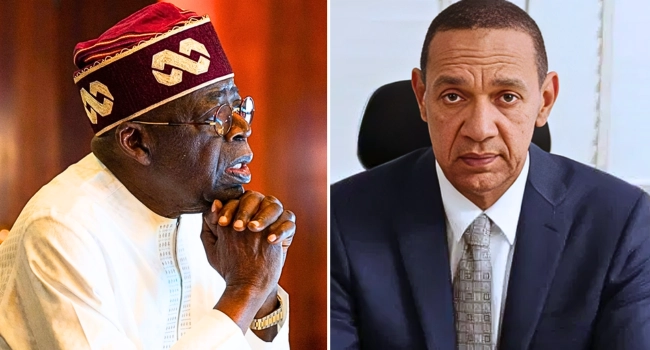
Former Bayelsa East Senator, Ben Murray-Bruce, has called on President Bola Ahmed Tinubu to initiate far-reaching reforms in Nigeria's electricity sector, declaring that the 2013 privatisation exercise has failed to deliver reliable power to Nigerians.
Murray-Bruce made the call in an open letter to President Tinubu posted on his X page, titled “Start the Dance on Electricity. The Privatisation Failed. The Owners Are Billing Darkness” on Saturday, August 29, 2026.
The former lawmaker said his intervention was not intended to attack individuals but to draw attention to what he described as a longstanding national problem requiring urgent action.
Citing figures he attributed to the Nigerian Electricity Regulatory Commission (NERC), Murray-Bruce said that out of 13,625 megawatts of installed generation capacity, only 4,286MW was available for dispatch in April, representing about 31 per cent, and further claimed that only 10 out of 28 power plants accounted for 81 per cent of the country's electricity generation, arguing that the figures expose fundamental weaknesses in the sector.
Murray-Bruce also drew attention to the sharp decline in electricity generation on Saturday, August 22, alleging that grid output dropped to 1,132MW at about 8:30pm after exceeding 4,000MW earlier that afternoon.
According to him, 12 generating stations, including Egbin, Geregu, Kainji, Shiroro and Zungeru, were producing no electricity at the time, a development he said demands greater accountability and explanation from operators and regulators, stressing that, “That is not an industry, Your Excellency. That is a rumour of an industry,” Murray-Bruce stated.
Turning his attention to the 2013 power sector privatisation, the former senator argued that the exercise amounted to a transfer of ownership without ensuring that the new operators possessed sufficient financial and technical capacity to effectively manage, expand and modernise the assets.
“The 2013 privatisation was not a reform. It was a transfer of custody,” he alleged.
Murray-Bruce maintained that while investors who acquired the Generation Companies (GenCos) and Distribution Companies (DisCos) might have had the financial resources to purchase the assets, many lacked the enormous capital required to operate and continually invest in a modern electricity system.
He argued that ownership of electricity infrastructure and the ability to adequately capitalise it are fundamentally different, stressing that Nigeria failed to sufficiently distinguish between the two during the privatisation process.
According to the former senator, a serious electricity distribution company serving a country with Nigeria's huge population requires a balance sheet running into billions of dollars rather than merely billions of naira.
He suggested that the assets would have been better placed in the hands of established multinational utility operators with proven technical expertise, global experience and the financial capacity to make substantial long-term investments in electricity infrastructure before expecting returns.
“We should have sold these assets to first-class multinational operators with global brands, technical depth and the capacity to sink billions of dollars into the network before earning a kobo back,” he stated.
Murray-Bruce consequently urged President Tinubu to confront the structural problems in the electricity industry and begin a new phase of reforms capable of delivering dependable power supply to Nigerians.
His intervention comes amid persistent concerns over inadequate electricity generation and distribution, grid instability, infrastructure deficits and the cost of electricity to households and businesses across the country.